

Speech becomes text as it is spoken. Two solutions, one technology: processing happens where the conversation happens.
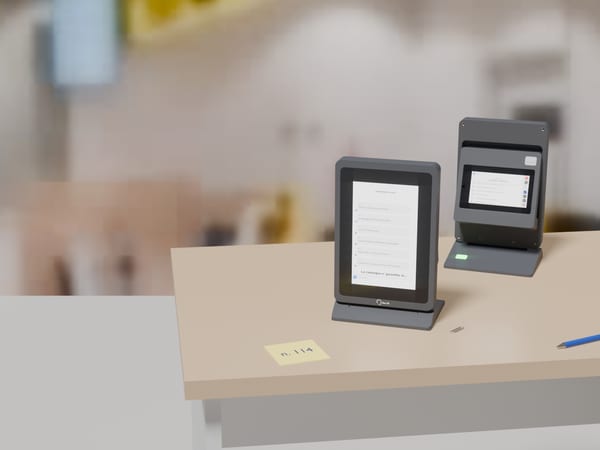
For offices
At the counter, people talk. From today, they can read it too.
Municipal offices, hospital receptions, banks, post offices, pharmacies. Two screens carry the conversation at the desk and a written summary is left at the end: the office becomes accessible in the way the European Accessibility Act requires.
See how it works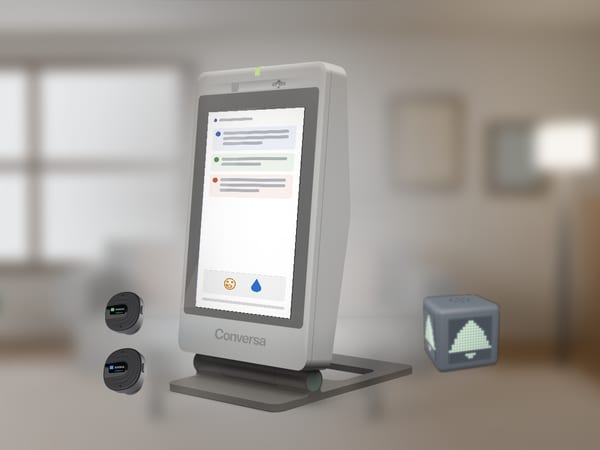
For individuals
From voice to meaning
A portable, self-contained device with a battery and a single button. It gives every voice a colour and uses light to flag the sounds that would go unnoticed: the conversation can be followed without asking anyone to repeat themselves.
See how it works


Accessible communication
Technology is there to let people communicate. Not the other way round.
We make communication accessible to everyone and simple to use, without asking anyone to learn a new device, so that each person stays part of what happens around them: for people living with a hearing, speech or sight disability, and for older people.
What it has to be
Three conditions, not three options.
Conversations break down every day for a technical reason: a pane of glass at the counter, the noise of a room, a noticeboard nobody updates. It is not for the person to work around that.
Inclusive
What is said or posted has to reach everyone: people who cannot hear, cannot speak, cannot see well, or have never got on with technology. It should take neither technical skill nor an expensive device bought at one's own expense.
Simple
No new device to study, no app to install, nothing to unlock or pair. The tools sit where they are needed and behave like the object they replace: a screen at the counter, a sheet on the wall.
Nobody left out
Knowing what is for lunch, whose birthday it is, when the service starts: those are the things that keep a person inside other people's lives. When they stop arriving — at the counter, in a family, in a care home — that is where loneliness begins.
7 million
People in Italy living with hearing loss.
Source: EuroTrak Italia (Anovum for EHIMA), reported by Il Sole 24 Ore, 2025
12.4%
Of the Italian population — the highest share of any major European country.
Source: EuroTrak Italia (Anovum for EHIMA), reported by Il Sole 24 Ore, 2025
28.06.2025
The date the European Accessibility Act started to apply. For services already running, the transition lasts to 2030.
Source: Directive (EU) 2019/882, Italian D.Lgs. 27 May 2022, no. 82, 2025
The platform
Speech today. Sign language next. Then sight.
The ecosystem grows: new capabilities arrive as accessories that work alongside the devices already installed, on the same infrastructure.
Live
Voice
Speech becomes readable as it is spoken, at the counter and at home, with a colour for each voice.
In development
Sign language (LIS)
Recognition of LIS captured by a webcam that joins the station.
Planned
Blind users
Support for people who cannot see, through dedicated accessories, on the same platform and within the same local processing boundary.
Capabilities that are not live yet are marked as such and are not part of today's installations.
For care homes
PaperComp
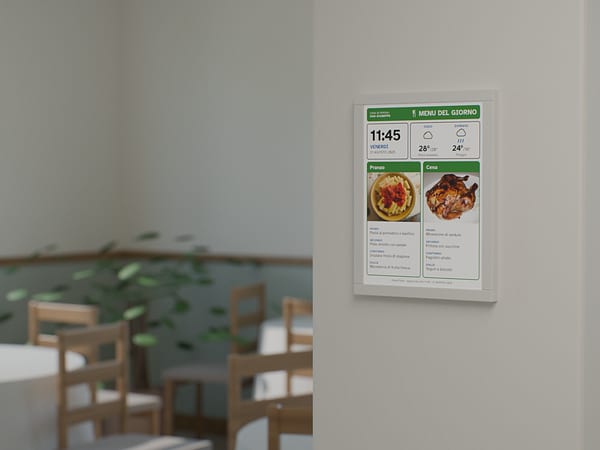
It looks like paper, but it updates when it matters.
eInk labels on the wall of a care home: the day's menu, birthdays, activities, service times, messages from relatives.
They keep residents inside the life of the home and in touch with the people they love — the first barrier against loneliness — without asking them to learn anything.
See how it works

Regulatory driver
For the services the European Accessibility Act covers, accessibility is an obligation.
The European Accessibility Act — Directive (EU) 2019/882, transposed in Italy by D.Lgs. 27 May 2022, no. 82 — has applied since 28 June 2025 to consumer banking services, e-commerce, electronic communications, passenger transport and e-books. Providers already running those services with products lawfully in use may carry on until 28 June 2030; self-service terminals already in service until the end of their useful life, and no more than twenty years from commissioning.
Penalties under D.Lgs. 82/2022 run from €5,000 to €40,000 (art. 24). The penalty of up to 5% of turnover comes from law 4/2004, and it hits large private operators — over €500 million of average turnover across three years — that ignore a formal notice from AgID.
Sources: Directive (EU) 2019/882; Italian D.Lgs. 27 May 2022, no. 82; Italian law 9 January 2004, no. 4.